
Best Practices For 2026
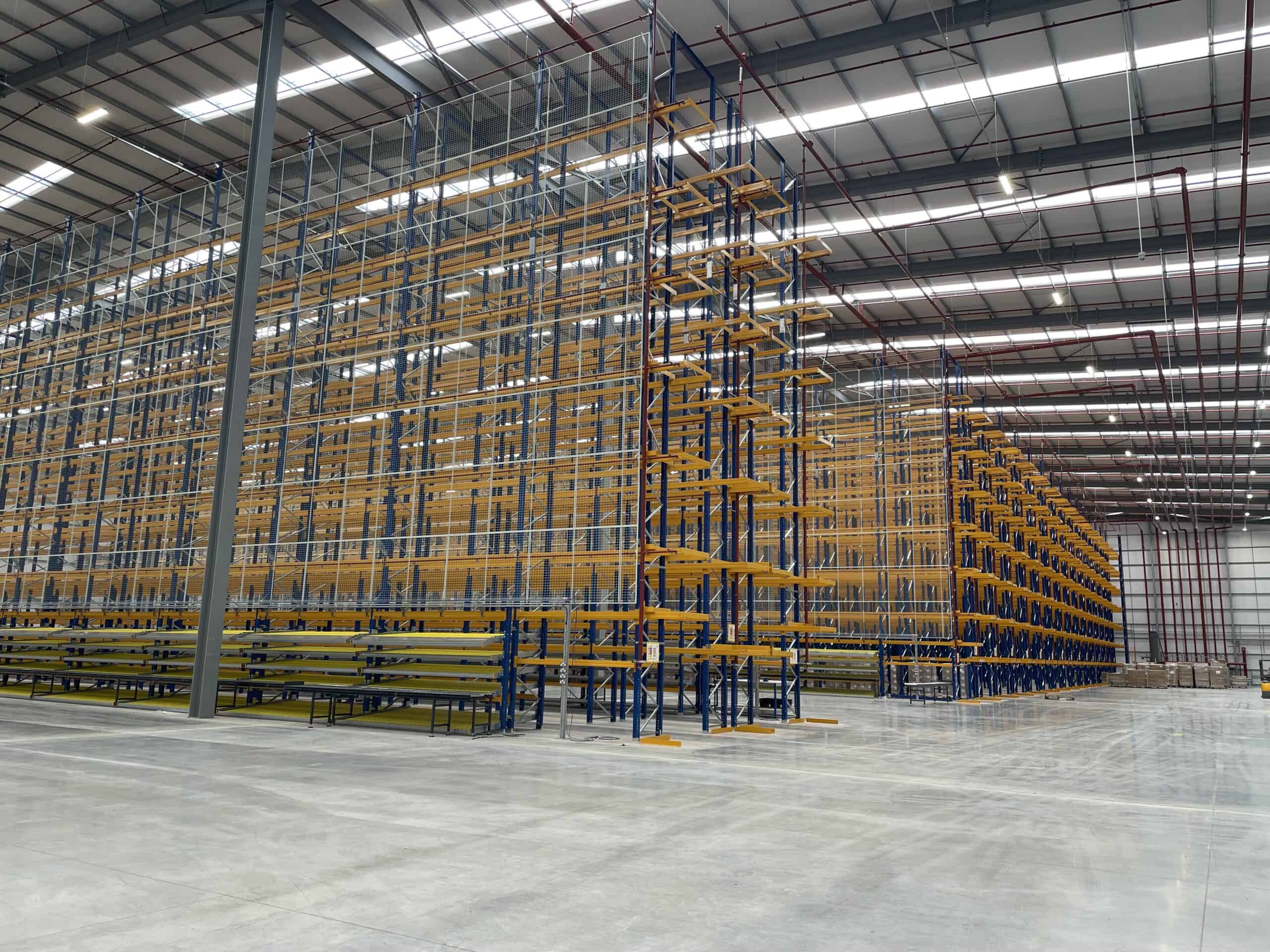
As UK E-Commerce continues to scale, fulfilment centres are under increasing pressure to operate faster, safer and more efficiently than ever before. Lighting plays a critical role in this environment, not just for visibility, but for productivity, energy performance and staff wellbeing.
For businesses investing in E-Commerce warehouse lighting in the UK, 2026 is all about smarter, more adaptive systems that support high-speed operations while reducing energy consumption.
Why Lighting Matters In Modern Fulfilment Centres
Unlike traditional storage warehouses, E-Commerce fulfilment centres are highly dynamic environments. High picking volumes, rapid movement of goods and reliance on scanning technology demand precise, consistent lighting. Poor lighting can directly impact accuracy, safety and employee fatigue.
In these settings, lighting must go beyond basic illumination; it should actively support operational performance.
Prioritise High Bay LED Warehouse Lighting
Most fulfilment centres feature high ceilings and dense racking systems, making high bay LED warehouse lighting the foundation of any effective scheme.
LED high bays are ideal because they:
- Deliver powerful illumination from height
- Provide uniform light distribution across aisles
- Reduce glare when correctly specified
- Offer long lifespans and minimal maintenance
Modern LED systems can also reduce energy consumption by up to 80% compared to legacy lighting, making them a key component of sustainable warehouse design.
For optimal performance, output and beam angle should be matched to ceiling height and aisle layout to avoid dark spots or excessive brightness.
Design For Task Specific Lux Levels
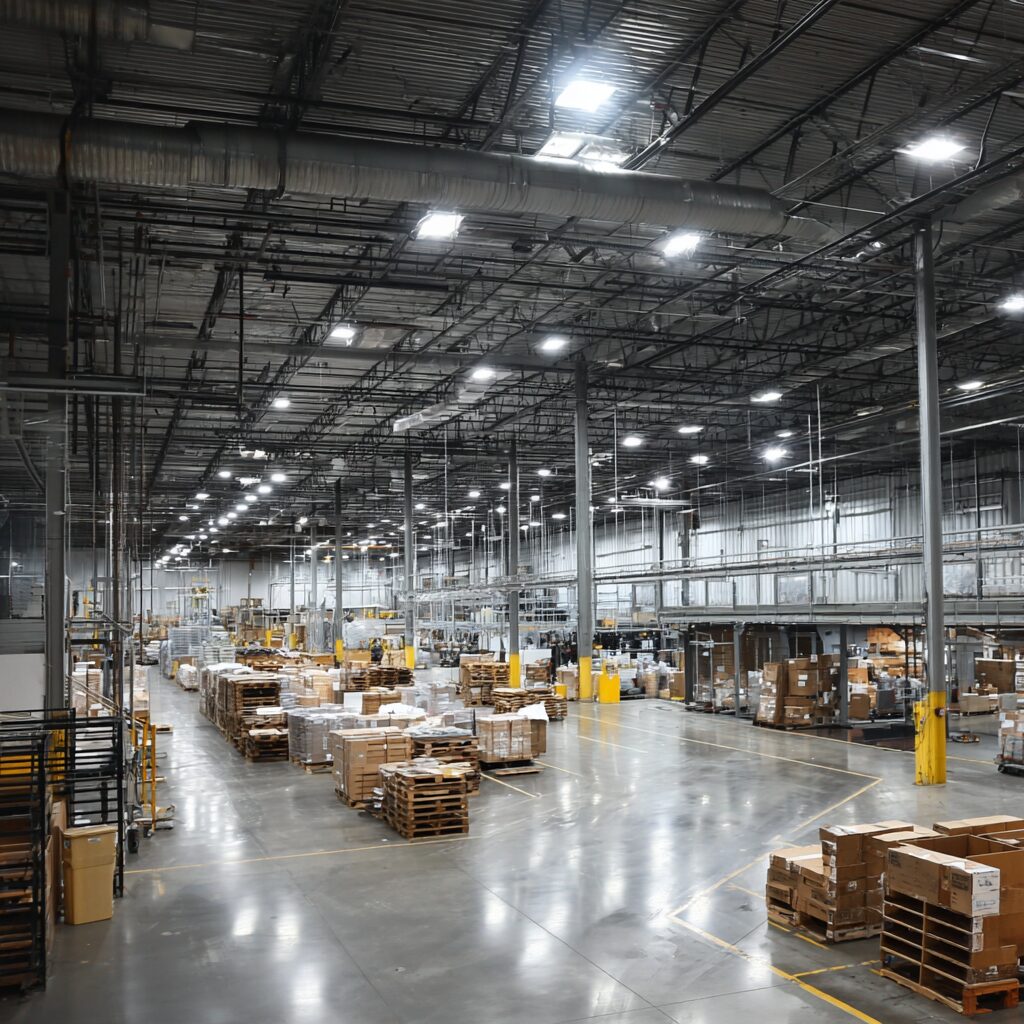
Effective fulfilment centre lighting design is not one size fits all. Different operational zones require different lighting levels:
- Storage aisles: ~150 lux
- Picking and packing areas: 300+ lux
- Low-traffic zones: lower levels with controls
These variations ensure that lighting supports both efficiency and safety without wasting energy.
Equally important is uniformity; consistent lighting reduces errors when reading labels, scanning barcodes and navigating racking systems.
For a deeper breakdown, see this warehouse lighting lux level guide.
Maximise Daylight Integration
Daylight is one of the most underutilised assets in logistics lighting. Incorporating skylights, roof lights or translucent wall panels can significantly reduce reliance on artificial lighting during daylight hours.
When paired with daylight harvesting controls, systems can automatically dim or switch off fittings based on natural light levels. This not only lowers energy usage but also creates a more comfortable working environment.
For large-scale logistics lighting UK projects, daylight integration is now considered a standard best practice rather than an optional upgrade.
Implement Intelligent Sensor Zoning
Lighting only where and when it is needed is essential for energy efficiency in modern fulfilment centres.
Sensor-based zoning includes:
- PIR or microwave motion sensors in aisles
- Occupancy-based lighting in low-use zones
- Time-based controls for shift patterns
Because many warehouse areas are not constantly occupied, these systems can deliver substantial savings with minimal impact on operations.
In 2025, smart lighting systems are increasingly integrated with warehouse management systems (WMS), enabling even greater control and automation.
Focus On Vertical Illumination
In E-Commerce environments, visibility is not just about the floor, it’s about what’s on the shelves.
Strong vertical illumination ensures:
- Clear visibility of labels and barcodes
- Faster picking times
- Reduced picking errors
Fulfilment centres typically require higher and more uniform lighting levels across vertical racking compared to traditional warehouses.
Lighting layouts should therefore be designed to illuminate both horizontal and vertical planes effectively.
Reduce Glare & Improve Visual Comfort
With the widespread use of handheld scanners and screens, glare control is increasingly important.
Key considerations include:
- Low-glare optics (UGR-controlled fittings)
- Appropriate mounting positions
- Balanced brightness levels
Excessive glare can lead to eye strain and reduce accuracy, particularly in high-speed picking environments.
Choose Scalable, Flexible Lighting Systems
E-Commerce operations evolve quickly. Layouts change, automation increases and demand fluctuates.
Lighting systems should therefore be:
- Modular and easy to reconfigure
- Compatible with smart controls
- Designed to adapt to changing layouts
Flexibility ensures long-term value and avoids costly redesigns as operations grow.
Build Sustainability Into Every Design
Sustainability is no longer optional in UK logistics. Lighting plays a major role in reducing a facility’s carbon footprint.
Best practices include:
- High-efficiency LED fittings
- Smart controls and dimming
- Reduced maintenance through long-life components
- Minimising light waste and over-illumination
By combining these strategies, fulfilment centres can significantly cut energy usage while maintaining high performance.
Conclusion
E-Commerce warehouse lighting UK is defined by intelligence, efficiency and adaptability. From high bay LED systems to daylight integration and sensor-driven controls, the right lighting design can transform a fulfilment centre’s performance.
For operators, the goal is clear: create a lighting strategy that supports speed, accuracy and sustainability in equal measure.
Looking for reliable and compliant ecommerce warehouse lighting UK solutions? Smart, energy-efficient systems are now the standard.
Contact Eco Lighting today to find out more.